

A collector-focused guide to Lionel’s 9700-Series boxcars, including the complete series, rarity notes, values, variations, overstamped cars, boxes, and packaging.
When General Mills took over the production of the Lionel trains in 1970, the toy train hobby was at a low point. By the mid-1960s the Lionel line had shrunk to a shadow of its former self. Model Products Corporation, the division of General Mills charged with reviving Lionel, began searching for ways to not only make Lionels popular toys once again, but to also start tapping into the rapidly growing collector's market that began to evolve in the latter part of the 1960s.
When it took over, MPC inherited Lionel's famous 6464 boxcar series. These cars, introduced in 1953, were a mainstay of the Postwar Era until the MPC takeover. In fact, several early 6464s were reissued in 1969. When MPC took over in 1970, they introduced their own version of the 6464s, the 9200 series.
Fifteen different 9200s were produced from 1970 to 1972. In 1972, the 9200s were supplanted by a new series, the 9700s [for more on the 9200 series, click here].
The 9700s formed the backbone of Lionel's freight car line throughout the 1970s. Lionel produced the 9700s at such a fast rate that they began to run out of numbers after only six years, and in 1978 the 9700s gave over to the 9400 series. The last 9700s were catalogued in 1979, except for a straggler that was made in 1982.
Eighty-one cars make up the complete 9700 series. This article is divided into the following sections:
Have fun!
Part 1: The 9700 Series

9700 Southern 1972-73

9701 Baltimore and Ohio Automobile 1972

9702 Soo Line 1972-73

9703 CP Rail 1972

9704 Norfolk and Western 1972

9705 Denver and Rio Grande Western 1972

9706 Chesapeake and Ohio 1972

9707 MKT Stock Car 1972-75

9708 US Mail 1972-75

9709 State of Maine 1972-74

9710 Rutland 1972-74

9711 Southern 1974-75

9712 Baltimore and Ohio Automobile 1973-74

9713 CP Rail 1973-74

9714 Denver and Rio Grande Western 1973-74

9715 Chesapeake and Ohio 1973-74

9716 Penn Central 1973-74

9717 Union Pacific 1973-74

9718 Canadian National 1973-74

9719 New Haven 1973

9723 Western Pacific 1973-74

9724 Missouri Pacific 1973-74

9725 MKT Stock Car 1973-75

9726 Erie Lackawanna 1978

9727 Tennessee, Alabama and Georgia 1973

9728 Union Pacific Stock Car 1978

9729 CP Rail 1978

9730 CP Rail 1974-75

9731 Milwaukee Road 1974-75

9732 Southern Pacific 1979

9733 Airco 1979
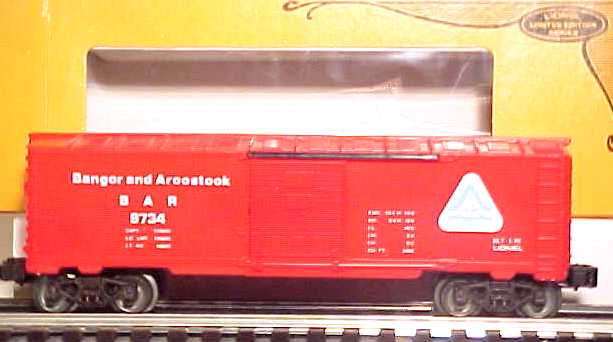
9734 Bangor and Aroostook 1979

9735 Grand Trunk Western 1974-75

9737 Central Vermont 1974-76

9738 Illinois Terminal 1982

9737 Denver and Rio Grande Western 1974-76

9740 Chessie System 1974-75

9742 Minneapolis and St. Louis 1973

9743 Sprite 1974-75

9744 Tab 1974-75

9745 Fanta 1974-75

9747 Chessie 1975-76

9748 CP Rail 1975-76

9749 Penn Central 1975-76

9750 Detroit, Toledo and Ironton 1975-76

9751 Frisco 1975-76

9752 Louisville and Nashville 1975-76
![Lionel 9753 Maine Central [Pictured with incorrect box]](https://trainz.co/%7Etrainzco/articles/9700Pics/9753.jpg)
9753 Maine Central [Pictured with incorrect box]
9754 New York Central Pacemaker 1975-77

9755 Union Pacific 1975-76

9757 Central of Georgia 1975

9758 Alaska 1975-77

9759 Paul Revere 1975

9760 Liberty Bell 1975

9761 George Washington 1975

9762 Toy Fair 1975

9763 Denver and Rio Grande Western Stock Car 1976-77

9764 Grand Trunk Western 1976-77
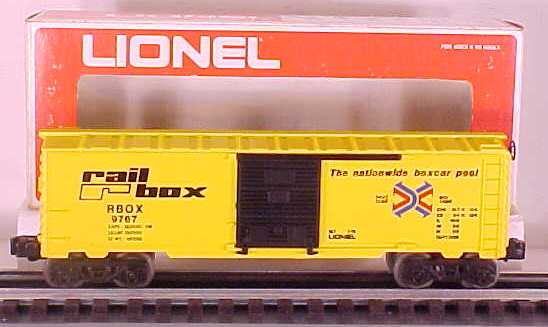
9767 Railbox 1976-77

9768 Boston and Maine 1976-77

9769 Bessemer and Lake Erie 1976-77

9770 Northern Pacific 1976-77

9771 Norfolk and Western 1976-77

9772 Great Northern 1976

9773 New York Central Stock Car 1976

9774 TCA 'Southern Belle' 1975

9775 Minneapolis and St. Louis 1976

9776 Southern Pacific Overnight 1976

9777 Virginian 1976-77

9778 Season's Greetings 1975

9779 TCA Philadelphia Convention 1976

9780 Johnny Cash 'Ridin' the Rails' 1976

9781 Delaware and Hudson 1977-78

9782 The Rock 1977-78

9783 Baltimore and Ohio Timesaver 1977-78

9784 Santa Fe 1977-78

9785 Conrail 1977-79

9786 Chicago and North Western 1976-77

9787 Central of New Jersey 1977-79

9788 Lehigh Valley 1977-79

9789 Pickens 1977
Part 2: Relative Values and Notes about the Cars
The value of the 9700 boxcars peaked in the 1990s and have dropped somewhat due to the proliferation of newer, similar cars on the market. Exact values of the cars vary, but as a general rule the series can be divided into three classes:
Class 1: The largest group, this is all of the common, regularly catalogued 9700s available for separate sale. All are relatively easy to find. If the car's number is not listed in one of the two classes below, it is part of this group.
Class 2: These are 9700s that were catalogued but only available in sets. They are still pretty easy to locate, but may command a slight premium. Some have die-cast trucks in place of the more common plastic design. This class includes the 9726, 9729, 9732, 9734, 9738, 9743, 9744, 9745, 9759, 9760, 9761, 9772, 9773, 9775, 9776, and 9789.
Class 3: These are uncatalogued cars. Some, like the 9742, are common, but others, like the 9778, are true rarities. The uncatalogued 9700s are the 9719, 9727, 9728, 9742, 9733, 9757, 9762, 9774, 9778, 9779, and 9780.
The 9703 CP Rail was produced primarily for the Canadian market and for some time was considered one of the rarest of all cars in the series. Over the years some have flowed back into the US, but the 9703 is still seen less often than most other early 9700s.
The 9719 New Haven was a 'coupon car'; you had to send two proofs of purchase and $5 to Lionel to get it.

All 9727 TA&G cars are stamped with serial numbers on the bottom. It is the only MPC-era car with this feature.

The 9733 Airco has a tank car body inside of it. The body can be trimmed out and installed on a frame.
The 9738 Illinois Terminal was the last car produced in the series. It was made in 1982 and was part of the Continental Limited Set from that year.
Like the 9719, the 9742 Minneapolis and St. Louis was a coupon car. For whatever reason it is much more common than the 9719.
The 9743 Sprite, 9744 Tab and 9745 Fanta were all part of the Coca Cola Train Set, which included the 8473 diesel switcher and 9073 caboose. These cars do not have original boxes.
The 9759 Paul Revere, 9760 Liberty Bell, and 9761George Washington were all part of the Libery Special set from 1975. Like the 9743-45, these cars do not have original boxes.


In 1991-92 Lionel produced two boxcars, the #19243 Clinchfield and #19244 Louisville and Nashville with 9700-series numbers printed on them (9790 on the Clinchfield, 9791 on the L&N). They are generally not considered part of the 9700 series.
Part 3: Selected Variations & Overstamped Cars
Compared to their 6464 and 9200 predecessors, there are very few major variations in the 9700 series boxcars. Some of the cars have minor variants, such as slight changes in the shade of paint, but larger, more noticeable variations in cars are few and far between with the 9700s. Why is this?
First, throughout the 1970s Lionel perfected painting and decorating techniques that were not available in the 1950s and 60s. New paint and decal applications meant that Lionel had better control over how the cars would ultimately come out once completed, preventing the 'trial and error' methods that caused many earlier variations. The number of cars with variations dropped dramatically beginning around 1973-74, right about the time the 9700 series was hitting its stride.
The second and more important reason was shortened production runs. Whereas many 6464 boxcars were catalogued for several years and were produced several times, most 9700s were produced only one year, and often were produced in only one production run. Even cars that were catalogued for more than one year were made in one run, as the cars were re-catalogued to sell the remaining inventory. (For a fascinating look at how Lionel made trains in the 1970s, see Volume 4 of The Lionel Collector's Guide and History by McComas and Touhy, which has a chapter showing Lionel's plant and assembly line circa 1979).
The only significant production variation occurred in a few of the early 9700s. All 9700 cars have small flat boards molded on the ends of each car. Most say '9700 Series', but a few early 9700s are stamped '9200 Series' instead; this was Lionel using up leftover 9200 bodies in 1972. The 9700 Southern, 9702 Soo Line and 9705 Rio Grande show up most often with this variation, which also provides a clue that these were the very first 9700s made.
A couple 9700s have easy-to-identify variations. Here are a few:
Some 9701s were made in black like the 9210 B&O boxcar. Black 9701s are very uncommon.
A few 9701s also have different-colored doors. These were post-factory alterations made for a Train Collector's Association [TCA] meet. While not true factory production, they are neat.
The 9730 was first made with white lettering and was later switched to black, which showed up better on the silver car. The black-lettered version is a bit less common.
Throughout the 1970s Lionel and some private individuals overstamped 9700s for collecting organizations and to commemorate the Christmas Season. The 9700s were good candidates for these projects as their large flat sides lent well for special lettering and decoration. Here are some of the 9700-series overstamped cars:
Selected Variations
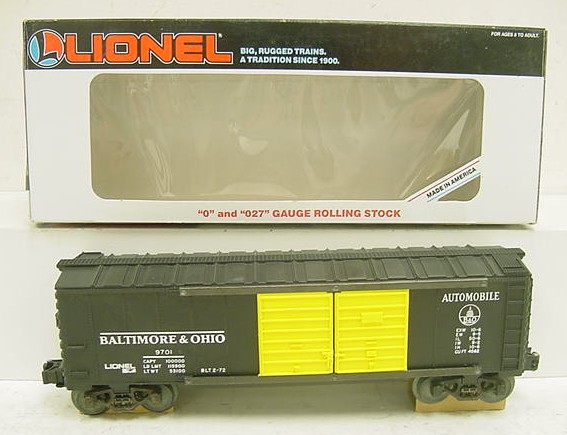
9701 Baltimore and Ohio
Some 9701s were made in black like the 9210 B&O boxcar. Black 9701s are very uncommon.

9701 Baltimore and Ohio
A few 9701s also have different-colored doors. These were post-factory alterations made for a Train Collector's Association [TCA] meet. While not true factory production, they are neat.

9730 CP Rail
The 9730 was first made with white lettering and was later switched to black, which showed up better on the silver car. The black-lettered version is a bit less common.
Overstamped Cars

9713 CP Rail Season's Greetings 1974

9730 CP Rail Season's Greetings 1976

9740 Chessie--TCA Great Lakes Division 1976

9754 New York Central--METCA Division 1976

9739 Rio Grande--TCA North Texas Chapter 1976

9771 N & W--TCA Museum Dedication 1977
(Author's note: This is not a complete list of all overstamped 9700 cars. If you have any photos of the other ones, we'd like to copy them for this article. Thanks!)
Part 4: Boxes and Packaging
9700 Series cars came in three types of boxes. The primary two were red with black and white lettering, and white with red and black lettering. The change from red to white boxes happened in 1976-77, and some 9700s from those years show up in both types of boxes, such as the 9768 Boston and Maine:

Three cars included in limited edition sets, the 9732 SP, 9734 Bangor and Aroostook, and 9738 Illionois Terminal, were packaged in special gold-colored boxes with black lettering:
Separate-sale 9700s always had the number and name of the car stamped in black on the endflap. Some 9700s included in sets, such as the 9789 Pickens car, came in boxes with no markings on the ends.
9700s were shipped from Lionel in cases of 12. Unopened cases show up occasionally on the collector's market.
Lastly, it should be noted that seven cars in the series--9729, 9743, 9744, 9745, 9759, 9760, and 9761-- do not have original boxes. They were all sold in sets packed in styrofoam liners.
Conclusion
In 1978, after six years of dominating the freight car pages of Lionel's catalog, the 9700s were superseded by the 9400s, and the last 9700s disappeared from the catalog after 1979. Apparently Lionel planned to fill in the remaining numbers in the series with limited edition cars, but only one, the 9738 Illinois Terminal, was made in the 1980s.
The 9700s were key to developing the collectible train market. The strategies Lionel developed to sell the 9700s are still used today. Limited editions, uncatalogued specials and convention specials all made their first appearance with the 9700s.
Today, the ubiquitous 9700s are a common sight, and no collection is complete without at least a few of these boxcars on the shelves or on a layout. They are a part of Lionel's enduring legacy and are a great starting place for the beginning collector.
Tommy Feldman
General Manager, Trainz.com
June 2009
Credits and Acknowledgements
The photos in the article were all taken at Trainz.com between 2001 and today.
Much of the information in the article was attained through observations and notes taken here at Trainz. David Doyle's Standard Catalog of Lionel Trains, 1970-2000, Roland LaVoie's Greenberg's Guide to Lionel Trains, 1970-91 (Volumes 1 and 2), and Touhy and McComas' Lionel: A Collector's Guide and History, 1970-80, were very helpful in filling in some gaps and confirming some of the information included in this article.
If anyone reading this article has any corrections, further information, or photographs of these cars that could enhance this article, feel free to contact me at tommy@trainz.com.
--Tommy