

Explore Lionel’s 9200 Series boxcars from the early MPC era, with model-by-model details covering the 15 cars produced from 1970 through 1972, along with production changes, packaging differences, and collector variations. This guide also follows how the 9200 Series developed from Lionel’s earlier 6464 boxcars and led into the 9700 Series that followed.
About the Lionel 9200 Series
General Mills took over the production of the Lionel trains in 1970 and began the task of reviving the toy train hobby. Lionel's line had shrunk to a shadow of its former self by the late '60s, and Model Products Corporation, the division of General Mills in charge of Lionel, began searching for ways to appeal not only to the toy market but to the rapidly growing collectors market as well.
When it took over, MPC inherited Lionel's famous 6464 boxcar series. These cars, introduced in 1953, were a mainstay of the Postwar Era. In fact, several early 6464s were reissued in 1969. It was only natural that Lionel would want to build on a popular idea, so in 1970 MPC/Lionel developed the replacement for the 6464s, the 9200 series.
Other than one variation - the orange and black 9202 - no 9200 is considered rare, and their prices remain very reasonable. They are a terrific opportunity for the variation collector and make for a nice colorful display on a shelf.
About This Guide: Originally written in 2009, this article has been updated for readability and presentation while preserving its original collector research and observations. References to rarity, availability, and market value reflect the model train market at the time of the original article and should be considered historical rather than current market information.
Lionel 9200 Series Boxcars
Lionel 9200 Illinois Central

The only car in the series catalogued during the entire 3-year run of the 9200s. Thus, the 9200 is the only car in the series that can exhibit every possible production variation. Later 9200s with molded-in bottom door guides are harder to find than the earlier variations. It was sold separately and included in several sets.
Lionel 9201 Penn Central

Made only one year, the Penn Central is a bit harder to find than some of the other cars in the series. 9201s only exhibit the characteristics of early 9200s--blank end boards, AAR trucks, metal door guides, and were packaged in the early white boxes.
Lionel 9202 Santa Fe

Like the 9201, the 9202 was available only one year and shows up a bit less often. Like the 9201, all 9202s have metal door guides, blank end boards, and AAR trucks. There is also a very rare preproduction variation of the 9202. It is orange with black lettering, similar to the 9200. According to the Lionel Collectors Guide and History, Volume 4, by Touhy and McComas, just 69 of these orange and black cars were made.
Lionel 9203 Union Pacific

All 9203s have the same early features of the 9201 and 9202, but all 9203s also have the incomplete rivet row just to the right of the door, legacy from the old 6464 cars. This feature makes it likely that the 9203 was the first of all 9200s produced (it's unlikely Lionel would have removed the rivet row from the mold and then put it back into the design for no apparent reason). The UP herald is a decal, and it is oftentimes chipped.
Lionel 9204 Northern Pacific

The 9204 had two distinct production runs. Early cars, like the one shown below, had blank end boards, metal door guides, AAR trucks, and were a dark green. Later 9204s, had 9200 end boards, plastic door guides, and the later truck design. Later 9204s were also painted a lighter shade of green.
Lionel 9205 Norfolk and Western

Another of the early 9200s, the N&W has metal door guides, AAR trucks, and blank end boards.
Lionel 9206 Great Northern

The GN occasionally shows up in a later red and white box, indicating 1972 production. This is one of the easiest cars in the series to locate.
Lionel 9207 Soo Line

Made in 1971, the 9207 has endboards marked 9200, AAR trucks, and metal door guides.
Lionel 9208 CP Rail

Another of the 1971 class of 9200s, the 9208 used plastic door guides. These guides were fragile [hence their short production life], and some 9208s have door guides with chipped corners.
Lionel 9209 Burlington Northern

In 1970 the Great Northern, Northern Pacific, and Burlington railroads merged to form Burlington Northern, so in 1971 Lionel followed suit and brought out a BN boxcar. Like the 9208, the 9209 usually shows up with plastic door guides, though some with the later molded in bottom door guide show up occasionally. These cars also turn up in the later red and white boxes, indicating that the 9209 was among the last of the 9200s produced.
Lionel 9210 Baltimore and Ohio

The 9210 was not based off of the 6464 design, but rather the 6468 double-door design from the Postwar era. Unlike the other 9200 cars, the 9210 retained the rivet detail on the car sides. The 9210 came with both AAR and later design trucks. Some 9210s had different colored doors installed outside the Lionel factory.
Lionel 9211 Penn Central

In 1971 Lionel re-ran a couple of the original 9200s, changing their decoration slightly. The 9211 Penn Central was the first. It was almost identical to the 9201 except that it had gray doors, a slightly duller color, 9200 printed on the end boards, and plastic door guides. The 9211 is easier to find than the 9201.
Lionel 9214 Northern Pacific

Lionel also re-ran the Northern Pacific name in 1971, but this time the car was painted in a more realistic tuscan color. Quite a few 9214s were made, and the car can be found with both types of trucks, all three types of door guides and with 9200 or 9700 endboards. It also was packaged in both the early white boxes and the later red and white boxes.
Lionel 9215 Norfolk and Western

Like the 9211, the 9215 was a rerun of the 9205 except that it had gray doors, a flatter color, 9200 printed on the end boards, and plastic door guides.
Lionel 9230 Monon
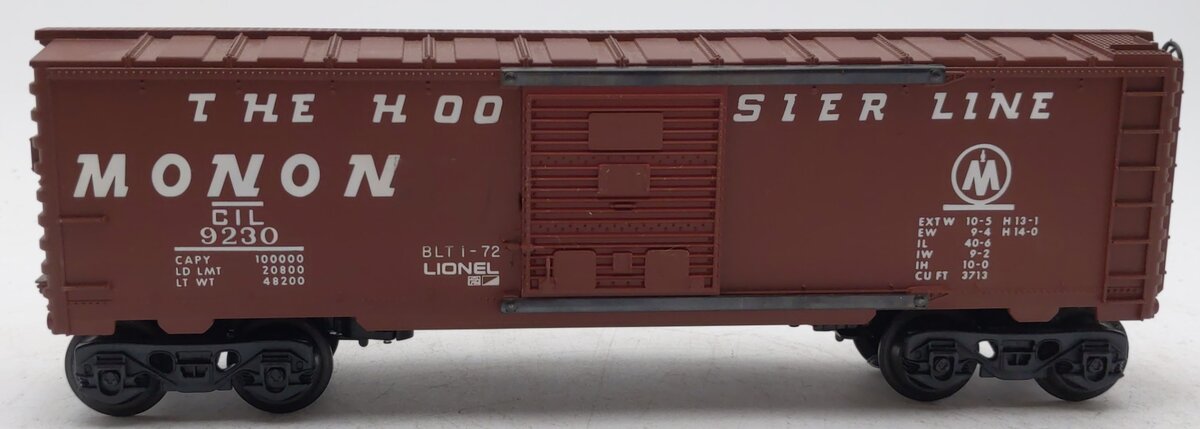
The 9230 Monon ‘The Hoosier Line’ has an unusual release history. It was included in Lionel’s 1971 Illinois Central Service Station Set (6-1187), while catalog and flyer records also list the car in 1972. As the last-numbered car in the 9200 series, it sits at the transition between the 9200 and 9700 collector boxcar lines. The car features sliding doors, plastic trucks with operating couplers, metal wheels and axles, and a metal frame.
Lionel 9200 Series Variations
There were five primary changes to the 9200s, which are listed below. Many of the cars also have subtle paint shade variations as well. These changes were not made concurrently, so there are many sub-variations as a result. Cars with plastic door guides can show up with either type of trucks, cars with metal door guides can have blank end boards or 9200 end boards, and so on. The ongoing evolution of these cars over such a short period of time is what makes them so interesting.
Rivets on the sides
When the 6464 boxcars were introduced, they had eight rows of rivets down each side of the car. As Lionel attempted more complex paint and lettering schemes, the rivets were gradually eliminated. The 9203 Union Pacific car has a half-row of rivets just to the right of the door on each side. These were quickly eliminated, and all other cars in the series had completely smooth sides. The rivet detail would not return to 6464-type Lionel boxcars until 1992.
Door Guides
Early 9200s used the same method to attach doors that was used on the 6464 series--two metal guides on each side, with each guide held in place by a pair of rivets. In late 1970 or early 1971 this was changed to a pair of plastic door guides that snapped into the car sides. These proved to be fragile, so some time in 1971 or 1972 the guides were changed again, to a snap-in plastic top guide, with a lower guide molded into the car body. This proved reliable and is still the door guide system used on many Lionel boxcars today.


End Boards
Early 9200s had blank end boards like their 6464 predecessors. Starting in late 1970, Lionel began molding '9200 Series' in one end board and the MPC logo in the one on the opposite end. In 1972, the 9200 end board was changed to 9700, and remained that way until the 1990s, even after the 9700s were discontinued.


Trucks
9200s from 1970 used the AAR-design truck that was developed by Lionel in the late 1950s. To enhance the rolling quality of the cars, the wheels and axles were pressed together, and the axle ends were filed to a point, increasing the rolling quality of the cars exponentially. Sometime in 1971, a new truck design replaced the AAR-type and remained standard until the mid-1980s. There is also a minor difference in the uncoupling mechanisms. The AAR trucks have a rectangular plate glued to the bottom of the coupler armature (the part you pull down to open the coupler), while the later trucks used a pressed-in thumbtack.

(1970-71)

(1971-87)
Packaging
Early 9200s came in a white box with red, white and blue lettering. In 1972 Lionel changed to a red box with white lettering, and a few of the last 9200s were in these boxes.


Conclusion
In 1972 Lionel changed to the 9700 series, and the short-lived 9200 era was over. The cars were a significant turning point for Lionel, as they symbolized a shift into making trains specifically for collectors. Easy to find and full of variations, the 9200s are a great starting point for any collection.
More to Explore from Trainz
Continue with more model train collector guides, shop Lionel MPC freight cars, or explore trains from across the MPC era.
Discover more Trainz guides covering Lionel history, collector series, locomotives, rolling stock, and the model train hobby.
Shop Lionel MPC Freight CarsBrowse Lionel freight cars from the MPC era, including vintage, collectible, pre-owned, discontinued, and hard-to-find models as available.
Explore Lionel MPC TrainsShop locomotives, rolling stock, train sets, and other Lionel trains produced during the MPC era.
Trainz has spent decades working with Lionel trains and collections, giving our team firsthand familiarity with the production details, variations, and collector features found throughout the MPC era.